
THE STORY
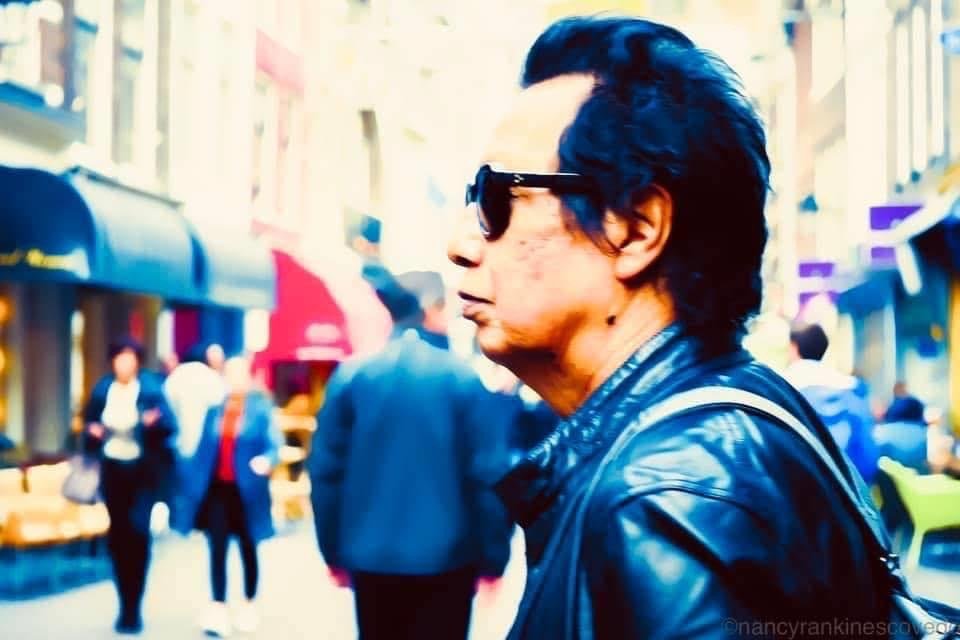
Photo: Nancy Rankin Escovedo
A celebrated singer and songwriter, Alejandro Escovedo has as eclectic a background and body of work as any rock artist of his generation. As comfortable performing with a string ensemble as he is with an amped-up power trio, and as likely to bare his soul in his lyrics as he is to display some serious rock & roll swagger, Escovedo had already played an important role in punk (with the Nuns), roots rock (the True Believers), and alt-country (Rank & File) before he launched a solo career that's seen him work with everyone from Tony Visconti, John Cale to Bruce Springsteen. Beginning with 1992's Gravity, Escovedo's music has been consistently literate, ambitious, and eclectic, with 2001's A Man Under the Influence exploring different genres and approaches from track to track, while 2008's Real Animal and 2016's Burn Something Beautiful focused on passionate, guitar-based rock & roll. 2018's The Crossing (and its 2021 Spanish-language counterpart La Cruzada) told a richly detailed story of the immigrant experience.
Alejandro Escovedo was born in San Antonio, Texas on January 10, 1951, one of 12 children. His family was steeped in music: His father played in mariachi bands and swing combos both before and after he emigrated from Mexico to the United States. Alejandro's older brother Pete Escovedo is a recognized jazz artist and studio musician; he was a member of Santana and founded the group Azteca. Another older brother, Coke Escovedo, also worked with both jazz and Latin groups, enjoyed a solo career, and was a member of Santana and Malo. Pete's daughter Sheila Escovedo became a pop star and an acclaimed drummer as Sheila E. Alejandro's younger brother Javier Escovedo founded the early Los Angeles punk band the Zeros. And another younger brother, Mario Escovedo, played in the hard rock outfit the Dragons.
Given his family's history, it's no surprise that Alejandro developed a passion for music. He moved with his family to California and attended school in Huntington Beach, where he frequented local rock clubs and ballrooms, seeing acts like Jimi Hendrix, Buffalo Springfield, the Doors, the Seeds, and the Flying Burrito Brothers. While Alejandro was a serious music fan, he didn't take to playing an instrument right away, and when his father gave him a guitar, he ended up passing it on to his brother Javier. Alejandro moved to Hollywood in 1973. He had always been a fan of glam and proto-punk acts like the New York Dolls and the Stooges, who frequently played on the Sunset Strip. He also saw an early L.A. appearance by Patti Smith. In 1974, Escovedo moved to San Francisco, with Bobbie Levie, where he intended to study film production. He and his friend Jeff Olener hatched an idea for a movie about a rock band that couldn't play, and while casting the picture, they ended up forming an actual band, The Nuns, who were one of the first acts of note on the San Francisco punk rock scene. The Nuns became a steady draw on the West Coast, and were one of the opening acts when the Sex Pistols played their infamous final show at Winterland in San Francisco in 1978. However, when The Nuns set out on an East Coast tour, Escovedo immediately fell in love with New York City, and opted to stay there rather than return to the Bay Area.
Escovedo became a figure on New York's Lower East Side music scene, and joined the band of avant-garde vocalist Judy Nylon. In 1980 he got a call from Tony and Chip Kinman of the Los Angeles-based leftist punk band the Dils. The Dils had just broken up and Kinman and Escovedo were forming a new band that would mix punk energy with country song structures; after the Kinman Brothers moved to New York, they joined Rank and File with Ritchie Dietrich and Jeff Raphael. Before long, the group settled in Austin, Texas and Escovedo played on the outstanding 1982 debut album, Sundown. However, he quit Rank and File in 1983 when he and his brother Javier chose to start a band of their own, the True Believers. With Austin native Jon Dee Graham joining Alejandro and Javier on guitars, the True Believers fused a rootsy approach with a heartfelt rock & roll attack, and they were stars in Austin and a favorite with critics. However, their self-titled debut album (released in 1986) didn't quite capture their on-stage impact, and a reorganization at their record company led to their second album being pulled from release only two weeks before it was due to come out. Frustrated, the True Believers broke up in 1988 (a retrospective album, Hard Road, was released in 1994 and included their unreleased second album), and Alejandro and Javier formed the short-lived, glam-influenced band Buick MacKane. During his time with the True Believers, Alejandro began focusing more seriously on his songwriting, and as he worked a day job at a record store, he began working out material with a diverse range of Austin musicians. Escovedo was soon playing out with a rotating variety of players he dubbed the Alejandro Escovedo Orchestra and he developed a new following in Austin. However, his marriage with Levie was falling apart, despite the couple welcoming a daughter in 1990, and the failing relationship began informing Escovedo's songs. In 1991, Levie committed suicide, and a year later, Escovedo released his first solo album, Gravity, through Austin's Watermelon Records label. A striking meditation on love, loss, and grief, Gravity received rave reviews, and Escovedo threw himself into his solo career. In 1993, he released his second album, Thirteen Years, a concept piece informed by the rise and fall of his marriage to Levie. In 1994, Escovedo was in a one-off semi-supergroup, the Setters, with fellow songwriters Michael Hall and Walter Salas-Humara, and signed a deal with Rykodisc, the independent label that successfully released the True Believers anthology. In 1996, they released With These Hands, Escovedo's ambitious third solo album, and a collection of Buick MacKane material, The Pawn Shop Years, followed in 1997. However, Escovedo's relationship with Rykodisc quickly crumbled when sales of With These Hands proved disappointing, and he was soon without a label.
It wasn't long before he found new champions at Bloodshot Records, Chicago's pioneering "insurgent country" label. Escovedo had assembled an album from a handful of live recordings, and Bloodshot released More Miles Than Money: Live 1994-1996 in 1988, in time for Escovedo to be named "Artist of the Decade" by alternative country journal No Depression. Escovedo also appeared on a Bob Wills tribute album assembled by Jon Langford with his ad hoc group the Pine Valley Cosmonauts, and in 1999 he released Bourbonitis Blues, a combination of live tracks and studio material that featured fresh originals alongside covers of songs by Ian Hunter, John Cale, and the Gun Club, among others. 1999 also saw Escovedo appear on the album More Oar: A Tribute to the Skip Spence Album, which featured him alongside Robert Plant, Tom Waits, Beck, Robyn Hitchcock, and many more. In 2001, he released A Man Under the Influence, an ambitious and musically diverse set that earned him some of his best reviews to date. The album also received some scattered airplay for the song "Castanets," though when Escovedo learned the song appeared in a mix on President George W. Bush's iPod, he declined to perform it again until Bush left office. Two songs on A Man Under the Influence were originally written for a play on the Mexican-American immigrant experience, By the Hand of the Father, and an album of the show's full score was released in 2002.
In April 2003, Escovedo was performing By the Hand of the Father in Tempe, Arizona when he collapsed shortly after the show ended, having vomited up blood earlier that day. He was living with Hepatitis C and the disease was threatening to claim his life. A heavy drinker at the time, Escovedo gave up alcohol and took on a rigorous regiment of treatment that was not successful. Lacking medical insurance, fans and musicians began sponsoring benefits to help cover his hospital bills, and in 2004, a double album entitled Por Vida: A Tribute to the Songs of Alejandro Escovedo was released to raise more money for the artist, featuring interpretations of his songs by Lucinda Williams, Los Lonely Boys, Charlie Musselwhite, Ian Hunter, the Jayhawks, the Minus 5, and 25 others. A collection of performances by the Alejandro Escovedo Orchestra was also released to fans under the title Room of Songs in 2005.
John Cale, long one of Escovedo's major influences, recorded a version of "She Doesn't Live Here Anymore" for Por Vida, and when Escovedo was healthy enough to begin working again, he invited Cale to produce his next album. The Boxing Mirror, his first release under a deal with the EMI-distributed Back Porch Music imprint, was a powerful effort released in 2006. In 2008, Escovedo went into the studio with David Bowie and T. Rex producer Tony Visconti to cut a lean rock & roll album, Real Animal, a set of songs co-written with guitarist Chuck Prophet, who anchored his new road band, the Sensitive Boys. Escovedo also joined a new management team, Jon Landau and Barbara Carr, who also handled Bruce Springsteen's career. Springsteen, a fan, brought Escovedo on-stage with him to perform a duet version of Escovedo’s "Always a Friend" during a stadium show in Houston, which appeared on Springsteen's EP Magic Tour Highlights. Springsteen also made a guest appearance on 2010's Street Songs of Love, another Visconti-produced set that was Escovedo's first release through Fantasy Records. 2012's Big Station would prove to be Escovedo's last album with Visconti and Prophet; and in 2014 set out on a co-headlining tour with former R.E.M. guitarist Peter Buck, in which Buck and his band (guitarist Kurt Bloch of the Fastbacks, bassist Scott McCaughey of the Young Fresh Fellows and the Minus 5, and drummer Bill Rieflin of Ministry and Swans) backed up Escovedo after finishing their own set.
A second tour with Buck and his band was put on hold after Escovedo had another health scare, and while honeymooning in Mexico with his wife, Nancy Rankin, their friends home was hit by a Category Four storm, Hurricane Odile. The two survived the impact and then struggled with PTSD in the wake of the hurricane, and sought therapies together as they struggled with its aftereffects. Rankin's work on “Queen of the South” TV series led the couple to spend over six months in Dallas, Texas, and Escovedo was invigorated by his new surroundings after becoming disenchanted with the growing gentrification of Austin. The Escovedos settled down in Dallas, as they healed and started creating again. At that time Alejandro decided to go forward with a Hepatitis treatment that cured him in 2016. Alejandro returned to an album he had planned to write and record with Buck and McCaughey. Recorded in Portland, Oregon with Buck, McCaughey, Bloch, and drummer John Moen of the Decemberists, 2016's Burn Something Beautiful also included guest appearances from Corin Tucker of Sleater-Kinney, Steve Berlin of Los Lobos, and frequent Neko Case collaborator Kelly Hogan.
A tour of Europe found Escovedo sharing stages with the Italian band Don Antonio, and Escovedo struck up a friendship with the group's leader, Antonio Gramentieri. The two collaborated on a set of songs about two young men -- one from Italy, one from Mexico -- who come to America to follow their dreams. Escovedo recorded the songs on his 2018 album The Crossing in Italy; Don Antonio served as his backing band for the sessions, with guest appearances from Wayne Kramer of the MC5, James Williamson of Iggy and the Stooges, John Perry with Peter Perrett of the Only Ones and Joe Ely. In 2019, Escovedo and his wife Nancy relocated outside of Austin, Texas in the hill country. Also in 2019, Alejandro received the “Townes Van Zandt Award” from Austin City Limits. He would then receive the “Independent Icon Award” from A2IM Libera Awards in 2020. In 2020, Escovedo issued La Cruzada, which featured Spanish-language interpretations of the 17 songs from The Crossing. The album first appeared in a limited-edition for Record Store Day, and was given a full release in September 2021. La Cruzada was a success on Billboard Latin charting the album at #8; Escovedo’s first. Alejandro was inducted into the “Austin City Limits Hall of Fame” in 2021. Alejandro was also inducted into the “Texas Heritage Songwriters Hall of Fame” in 2023. Escovedo’s latest album Echo Dancing was recorded in Italy and was released March 29, 2024. Revisiting rarities from albums past and reimagining them into an electric but rock n roll soundscape. Echo Dancing secured a #1 spot in Top 5 Country Albums for Classic Rock Magazine. Escovedo continues to create with a mythical memoir in the works and is currently in the studio recording with Britt Daniel of Spoon and Charlie Sexton producing. Stay tuned! South Congress Serenade Live at The Continental Club is hot off the press and available at our live shows for now. Come celebrate with us and acquire your first pressing on double vinyl!
__________________________________
“Musically, Alejandro Escovedo is in his own genre.” – David Fricke, Rolling Stone
“There are songwriters who sing their songs, and then there are songs who sing their writers.” – Lenny Kaye ( Patti Smith Band)
“A masterwork from one of the genuine lights in rock music.”- Billboard
“Escovedo has blended the lyricism of Bruce Springsteen and Jackson Browne with the raw power of the Stooges and the Velvet Underground…the result is music with heart, brains, and a burning sense of adventure.”– Mark Kemp, Rolling Stone
“The performances were lush and full…it was truly a treat to hear these songs with such a rich resonance that only added to their depth and beauty.” – Front Row Center
“Alejandro Escovedo likes songs with stories; tonight, he was, the American story.” – The Boston Globe
“Alejandro Escovedo is one of the great songwriters of our time.” – Time Out Philadelphia
“Alejandro Escovedo was like a lean slice of nighttime that had found its way into a sunny afternoon. That set was rumbling roots-punk guitar gunslinging at its most fierce and hip. After a long afternoon on a festival stage, the 60-something Escovedo still bristled with energy. Cool cats get nine lives. Ticking it off on your fingers, it seems as if the Texas songwriter must have cycled through all of those and then some.” – Allison Fernstock, New Orleans Times-Picayune
ACCOLADES
1993 Musician of the Year for the Austin Chronicle Music Awards
1996 Singer/Songwriter of the Year for the Austin Chronicle Music Awards
1996 Austin Arts Hall of Fame Inductee
1998 Artist of the Decade for No Depression Magazine
2006 Americana Music Association's Lifetime Achievement Award for Performing
2019 Townes Van Zandt Songwriting Award for Austin Music Awards
2020 Independent Icon for A2IM Libera Awards
2021 Austin City Limits Hall of Fame Inductee
2023 Texas Heritage Songwriters Hall of Fame Inductee
2024 Official proclamation from the State of Texas, presented by the Texas Music Office, recognizing Alejandro’s contributions to Texas music and the culture of the State